
How to Rotate to Zone
Get ready, because this is a BIG one...
- Rotation is a complex topic that many people have tried to nail down with a consistent strategy. However, with next-zone placement not following a consistent pattern late in game, and different strategies being applied by competitors, different maps and different meta each season, and depending on how many people remain in game at the time, providing exact logic for how to rotate is essentially impossible.
- So instead, we’ll explain here how to think about zones and rotation, what to look for so you can determine what you should do, and how to go about doing it.
- First, let’s talk about zones in general.
- The first zone is quite large and encompasses most of the map. Each of the next few zones is a smaller subset of the zone that came before it.
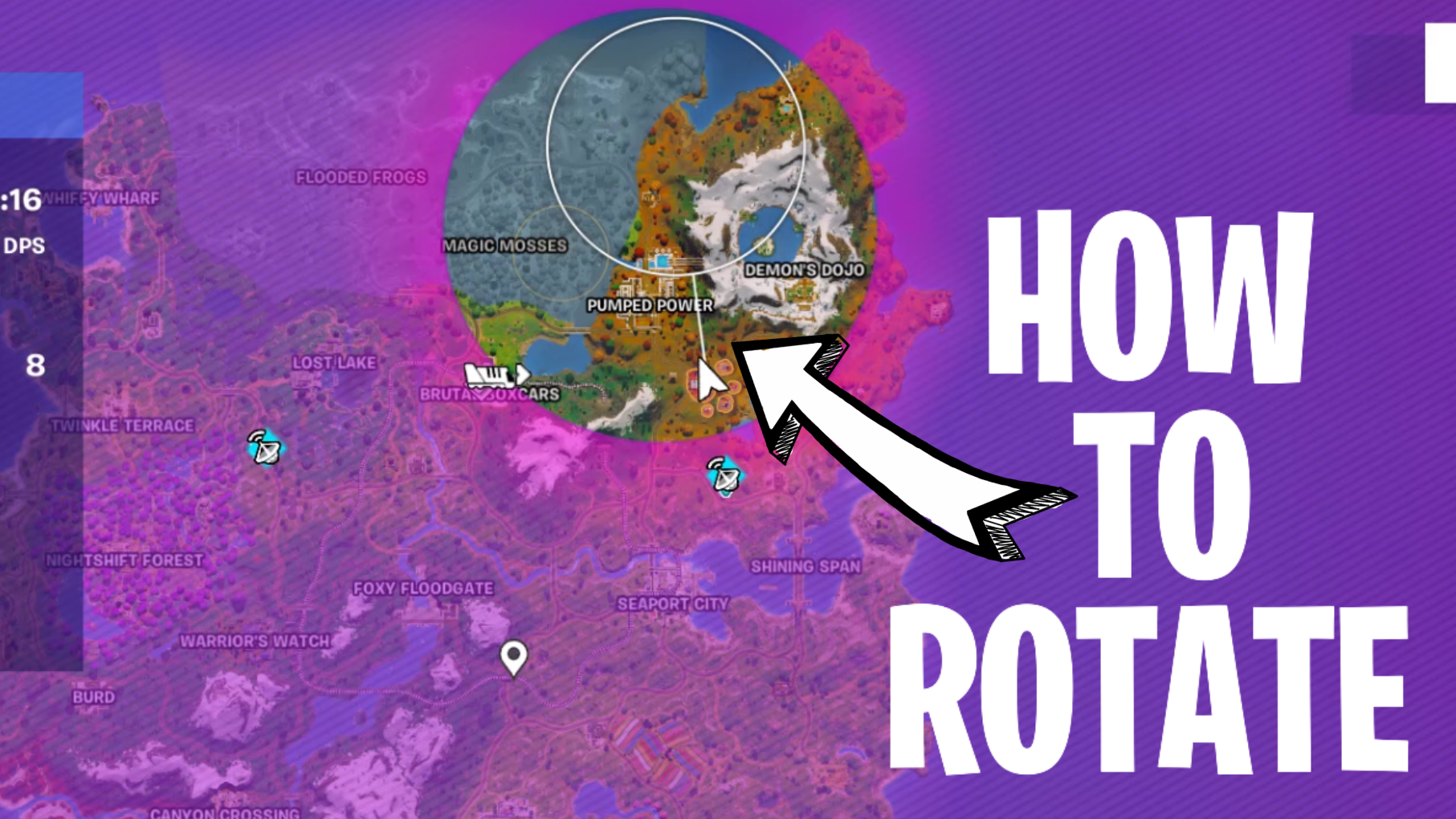
- However, later in game, next zones may be partly or completely outside of the current zone, so they may no longer be subsets (or within) the current zone. Not only does the circle shrink, but it may move partially or totally outside of the current circle as well. This can complicate movement within the zone and rotation to the next zone. This movement of the zone to a location outside of the current zone can begin at 7th zone.
- Now, let’s talk about the concepts of different areas of a zone
- Dead side is the side of the zone where fewer players currently are. It can take longer to get to this side of the zone while avoiding the other sides, but it is a safer space to be in and provides some strategic benefit on the attack as well. Dead side is a good place to reduce being targeted, but it is also a place where there are fewer people to target. This is important when we consider the concept of storm surge damage.
- Up until 7th zone, Dead side is generally created by being the side of the new zone that is closest to the edge of the old zone. This is because of how the zone becomes a subset of the prior zone and pulls people from the larger space into the smaller space within the original space.
- But once the zone starts moving outside of itself (whether overlapping prior zone or moving completely outside of prior zone), dead side is the side furthest from (outside) prior zone.
- Congested side is the side that has the most people and usually the teams carrying the medallions, if a given season has medallions, or the highest power weapons. This is the most dangerous place to be caught rotating but is often the quickest rotate (shortest path) to get to zone. You are most likely to be targeted in this area, but also have more competitors to target to manage the potential of storm surge damage.
- Up until 7th zone, Congested side is generally created by being the side of the new zone that was furthest from the edge of the old zone. This is because of how the zone becomes a subset of the prior zone and pulls people from the larger space into the smaller space within the original space.
- But once the zone starts moving outside of itself (whether overlapping prior zone or moving completely outside of prior zone), congested side is typically the side closest to (or still inside) prior zone.
- Mid zone is the area in between the dead side and congested side. As you might expect, this is a balanced area to be in.
- Choosing which area to go to or pass through will be determined by your actual scenario. At each new zone change, you should ask yourself the following questions:
- Where are you coming from relative to the new zone?
- How healthy are you currently, in terms of health and shield?
- How much damage have you dealt and are you at risk of storm surge damage (if applicable)?
- Do you have any ability (medallion, Forecast Tower, etc, depending on the season) that allows you to see the future zone? (this provides a strategic advantage when it comes to zone management and rotations as you can plan ahead to get the best spots in the new zone before others can get there)
- Do you have any opponent marking ability (medallion, flare gun, recon scanner, etc, depending on the season)?
- How much health and how many heals do you have? (this is important to determine if you can survive movement through the storm or through a congested area where you could take damage)
- What mobility items do you have? (if you have something that enables quicker movement, low gravity, or ability to reach height easily, this allows you additional realistic options for the path you take in your rotation.
- But it’s still not that easy. You may not be able to go exactly where you want due to other competitors, lack of materials for building, lack of mobility items, etc. One of the things we recommend above all else during rotations is to try to do so without drawing too much attention. Try to use the natural terrain to hide your rotation from being obvious and to provide shot cover. This may mean going low behind a cliff, or going high along a cliff where the angle makes it harder for opponents to spot you. Late in game, and especially in tiny circles, there may be little natural terrain to take advantage of. In this case, use builds (existing or new) to protect yourself during movement.
- When you reach your desired location in zone, or along the way if you are going to be exposed during rotation, try to maintain height. Having height is almost always strategically to your advantage for protection, awareness, and attack. Holding or getting height should often be a part of your rotation application.
- If you’re playing in highly competitive lobbies, unprotected movement (i.e. out in the open) is especially risky, as the best players have good enough aim to hit you in motion with relative ease. This doesn’t mean you shouldn’t use mobility items, but you should combine them with an intentional path to reduce your exposure and potentially avoid drawing attention to yourself.
- If you’re playing in less competitive lobbies, you can use whatever mobility items are available in the season (shockwaves, crashpads, launch pads, rifts, flowberry fizz, jetpacks, cars, helicopters, boats, etc) to move with far less risk of being hit while moving.
- Any element of movement that provides some level of additional protection (car, helicopter, etc) is beneficial if you’re going to be within shot of someone. Note that such items are less frequently available later in game though, so the items you can carry with you are more likely candidates for movement late in game.
- In any case, it is usually to your advantage to move as quickly as possible. See our module on “Keep Moving” to see what we mean by quick and continual movement.
- Especially late in game and in tight areas of short travel, ensure you are creeping instead of walking/running to avoid footprints showing up in visual sound effects.
- So what part of zone should you be in and how should you get there?
- Well, it depends on your desired play style or strategy in the moment…
- To strategically prioritize survival (passive strategy), we recommend trying to be in dead zone at all times, and rotate to new dead zones either through the current dead zone, through the storm, just ahead of the edges of storm, or at the edges of zone around dead side or mid zone. If you want to prioritize survival, you should stay away from the congested side at all times.
- If it’s prior to the 7th zone, you can try to travel just inside the arc of the storm circle, towards dead side, to get to the new zone circle, keeping you as far from congested areas as possible and outside of storm damage.
- To balance survival and eliminations, we recommend trying to be in between the dead side and mid zone, and rotate through the least congested areas possible to get back to the new mid zone as it moves. This will allow you to ideally stay ahead of opponents who are having to rotate through congested side or through storm, allowing you to take the time to go to height or build to height, then watch the movement of others in the distance and around you and pick them off as opportunities allow.
- If you can fight decently well but aren’t trying to push the entire lobby, hanging out in mid zone is where you should try to be. This will reduce the average distance you have to travel to new zone, at least up until 7th zone.
- To prioritize eliminations and push the entire lobby (aggressive strategy), we recommend you live between the mid zone and congested side. This will allow you to participate in the fighting in the congested area, but have a little less to worry about behind you.
- If you need to deal heavy damage to avoid storm surge, you should be targeting the congested side of the zone, either from within it or from the edge of the mid-zone.
- Note that you’ll need to apply different strategies or approaches at different times, whether from game to game or even within a single game with each new zone. Plan ahead though and continually ask yourself the questions above to think through what your best option really is, based on your level of aggression and overall loadout, etc.
- Timing of rotation is also a critical strategy
- Generally the earlier in game it is, the later you can rotate, and the easier it will be, as there will likely be fewer challenges due to less opponent density. You can also stand to get hit by the storm for longer the earlier it is, as the storm damage starts small but will increase with each zone. This allows you to stay in storm and rotate into zone super late if you want to, earlier in game.
- As you approach mid game, you’ll need to think about next zone at about the halfway point in time between when zone is identified on the map and when storm will fully close on it, depending on your strategy. The storm still isn’t doing heavy damage in mid-game, so you can rotate in storm late if you want, but not as late as in early game. You don’t want to be too late to rotate, especially if you’re not entering the dead side, as opponents in the congested side will be trying to target you and hold you back in storm.
- In late game / end-game, you’ll need to immediately recognize the new zone when it is identified on the map and plan your movements to it in such a way that aligns with keeping you in zone as it actually moves so you can avoid storm damage. You’ll need to move much more carefully at this time, as the zone is small and congested, and the players that remain are generally the better ones from that game’s lobby (duh, right? Kinda goes without saying). You’ll of course want to avoid storm unless you’re already in a heal-off, as it will do far more damage in end-game timing.